
 Afrika
 Asia
Asia Ulaya
Ulaya Amerika Kusini
 Australia na Oceania
 Antaktika
 Bahari ya Pasifiki
 Bahari ya Atlantiki
 Bahari ya Hindi
 Bahari ya Aktiki
 Bahari ya Mediterania
 Bahari ya Shamu
 Bahari ya Karibi
 Bahari ya Matumbawe
 Bahari ya Kusini ya China
 Bahari ya Ufilipino
 Bahari ya Andaman
 Bahari ya Kaskazini
 Bahari ya Timor na Arafura
 Ghuba ya Bengal
 Ghuba ya California
Black long-spined urchin
 Miiba yenye sumu
The black long-spined urchin is a sea urchin with very long, hollow spines. It lives on coral reefs, sand flats and seagrass beds across the Indo-Pacific, and it is one of the most widespread sea urchins in that region. Its spines can deliver a mild venom, so it is best to watch where you put your feet.1


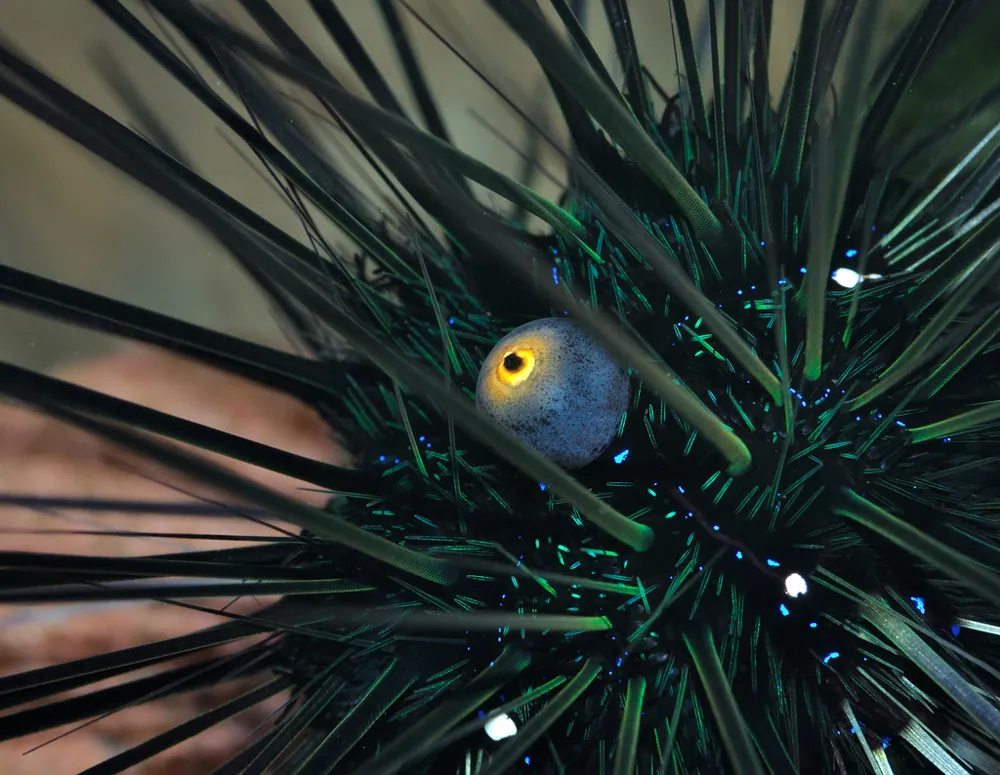
 Jinsi ya kumtambua
- Black, near-spherical body (test) with extremely long, narrow, hollow spines, often black but sometimes brown-banded1
- Five white spots on the body, which separate it from other Diadema species1
- A bright orange ring around the periproctal cone (the 'anal cone'), which is often mistaken for an eye1
- Bluish spots on the genital plates and a line of blue spots along the body1
- Adults are no more than 70 mm across the body and about 40 mm high1
Mara nyingi huchanganywa na: Other Diadema species are similar in shape and spines, but they lack the five white spots that mark this species. Its orange ring and blue spots also help to tell it apart.1
Nguvu ya sumu
Miiba mikali hubeba sumu. Kumkanyaga au kumshika kunauma.
Sumu yake hufanya nini?
The spines are hollow and contain a mild venom. The toxin mostly causes swelling and pain, which spreads gradually over several hours. The venom is not fatal to humans. The spines themselves are a bigger problem, because they are brittle and needle-like, break off in flesh and are difficult to remove.1
Ana hatari gani kwa watu?
Hatari kwa watu: InaumaInaweza kuuma sana, lakini karibu kamwe si jambo zito.The venom is only mild, and the species is not considered a serious threat to humans. Stepping on it can cause painful stings.1
Hufanya nini akiogopa?
When threatened by a sudden impact or by spines snapping, it rapidly flips its body over and 'runs' on the tips of its longest spines.1
 Miiba yake ikikuchoma
- Weka jeraha kwenye maji ya moto, moto kiasi ambacho mtu anaweza kuvumilia bila kuungua, na utafute msaada wa kitabibu kuondoa miiba. Usiichokonoe mwenyewe.
Daima piga namba ya dharura kwanza (112, 000, 911). Huu ni mwongozo wa jumla wa huduma ya kwanza, si ushauri wa kitabibu. Misingi ya huduma ya kwanza
 Kaa salama
- Kamwe usimguse, kumkamata wala kumchokoza mnyama wa porini, hata akiwa mdogo, na hata akionekana amelala au amekufa.
- Mpe nafasi. Ukikutana naye, tulia, rudi nyuma polepole na umwache aende zake.
- Miiba yake ikikuchoma: tulia, usitikisike, piga namba yako ya dharura (112, 000, 911) au nenda hospitali haraka. Kumbuka alivyoonekana, picha husaidia.
Hakuwindi wewe. Hutumia sumu yake kukamata chakula au kujilinda, na hupendelea zaidi kujificha. Zaidi kuhusu kukaa salama
Wapi duniani?
Ana ukubwa gani?
Ana urefu gani?
Ana uzito gani?

 urefu sawa na matofali 2 ya kuchezea yaliyopangwa mstari
 polepole kuliko konokono wa bustanini
Black long-spined urchin ana ukubwa gani ukilinganisha na WEWE?
Ni hesabu tu kwenye kivinjari chako. Hakuna kinachohifadhiwa wala kutumwa popote.
Ana kasi gani?

Ukweli
It can move 760 mm in just 7 seconds by rolling and walking on the tips of its spines.1
It has no eye, but it has a diffuse light-sensing system that lets it detect light levels and the size and colour of objects.1
In 2006, living specimens were found off Turkey, making it the first invasive Erythrean sea urchin recorded in the Mediterranean.1
Goose barnacles of the genus Microlepas are known to live on it as parasites.1
It is considered one of the oldest living species in its genus, Diadema.1
Kuvunja dhana potofu
Dhana potofu: Black long-spined urchins are deadly and their stings can kill people.
Ukweli: Their venom is mild and is not fatal to humans. The main problems are pain, swelling and spines that break off in the skin.1
Kwa wataalamu wa sumu
- Jina la kisayansi
- Diadema setosum
- Kundi
- Koche, nyota wa bahari na minyoo
- Familia
- Diadematidae2
- Mpangilio
- Diadematoida
- Mabara
- Bahari ya Hindi, Bahari ya Pasifiki, Bahari ya Shamu, Bahari ya Matumbawe, Bahari ya Ufilipino, Bahari ya Arabia na Ghuba ya Uajemi, Bahari ya Timor na Arafura, Ghuba ya Bengal, Bahari kuu
- Watoto
- It is a broadcast spawner, releasing eggs and sperm into the water. Spawning happens seasonally or year-round depending on the location, and in some places it follows the full moon.1
- Hatari kwa watu
- 2 / 5: Inauma3
Ukweli unatoka wapi
- Diadema setosum (Wikipedia (CC BY-SA 4.0))
- Diadema setosum (iNaturalist): majina na uainishaji.
- Venom Wiki: kiwango cha hatari, ukubwa wa kawaida na makadirio ya kasi ni yetu wenyewe. Ona jinsi tunavyovipata: Jinsi tunavyopima hatari.
Kila ukweli kwenye ukurasa huu una namba inayoonyesha chanzo chake. Kama tumekosea kitu, samahani, sisi ni wapenzi wa wanyama, si jarida la kisayansi. Tuambie kupitia [email protected] nasi tutarekebisha.
 Nge ana njaa! Venom Wiki ni mradi wa mtu mmoja: bure, bila matangazo na bila vifuatiliaji. Mchango mdogo husaidia kuiweka hewani.Mlishe nge
Zaidi kutoka kundi hilohilo: Koche, nyota wa bahari na minyoo
 Crown-of-thorns starfishKoche, nyota wa bahari na minyooAnahitaji daktariUsiguse
 Flower urchinKoche, nyota wa bahari na minyooAnaweza kuua
 Fire urchinKoche, nyota wa bahari na minyooAnahitaji daktariUsiguse
 Bearded firewormKoche, nyota wa bahari na minyooInauma tuUsiguse
 BloodwormKoche, nyota wa bahari na minyooInauma tu
 Bobbit wormKoche, nyota wa bahari na minyooInauma tu
Pia anaishi: Bahari ya Hindi
 Australian box jellyfishYavuyavu na wadungaji wa bahariniAnauaUsiguse
 Geography coneKonokono koni na pwezaAnaua
 Greater blue-ringed octopusKonokono koni na pwezaAnaua
 Southern blue-ringed octopusKonokono koni na pwezaAnaua
 Hawksbill sea turtleWanyama wengine wenye sumu ya kugusa au kulaAnaweza kuua
 Irukandji jellyfishYavuyavu na wadungaji wa bahariniAnaweza kuuaUsiguse