
 Afrika
 Asia
Asia Ulaya
Ulaya Amerika Kusini
 Australia na Oceania
 Antaktika
 Bahari ya Pasifiki
 Bahari ya Atlantiki
 Bahari ya Hindi
 Bahari ya Aktiki
 Bahari ya Mediterania
 Bahari ya Shamu
 Bahari ya Karibi
 Bahari ya Matumbawe
 Bahari ya Kusini ya China
 Bahari ya Ufilipino
 Bahari ya Andaman
 Bahari ya Kaskazini
 Bahari ya Timor na Arafura
 Ghuba ya Bengal
 Ghuba ya California
Flower urchin
 Kudungwa
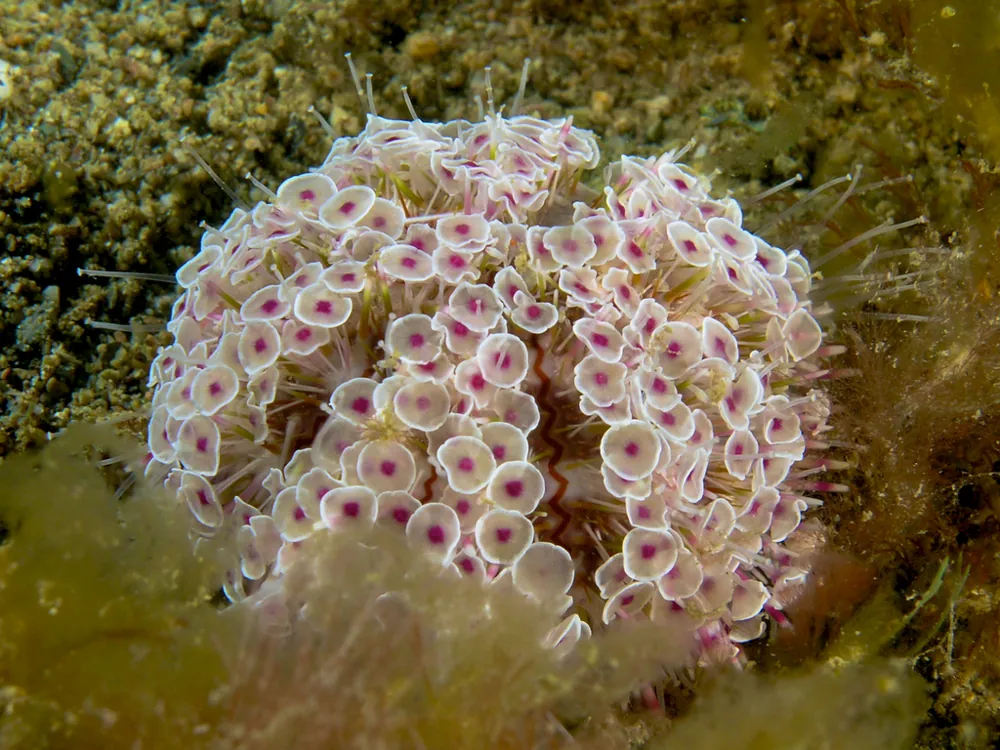
The flower urchin is a sea urchin with flower-shaped claws that can sting. It lives on coral reefs, in seagrass beds and on rocky or sandy sea floors across the Indo-West Pacific. It is one of the sea urchins most likely to cause a painful and medically significant sting.1
 Jinsi ya kumtambua
- Flower-like claws (globiferous pedicellariae) that are pinkish-white to yellowish-white, with a central purple dot and a bright white rim1
- A rigid shell (test) that is deep red and grey, with a purple zigzag pattern along each of the five ambulacral segments; rarely it is greenish or pale purple1
- Short, blunt spines, usually hidden beneath the flower-like claws1
- A body diameter of about 15 to 20 cm1
Mara nyingi huchanganywa na: Other Toxopneustes urchins look similar. Toxopneustes roseus has a uniform pink, brown or purple test and lives only in the eastern Pacific. Toxopneustes elegans, found only around Japan, has a dark stripe just below the tips of its spines. Toxopneustes maculatus is very rare, known from Réunion, Christmas Island and Palmyra Atoll, and has bright violet on its underside and a violet band around its middle.1
Nguvu ya sumu
Sumu hutoka kupitia mdungo.
Sumu yake hufanya nini?
Its venom is made in glands at the base of the flower-like claws, not in the spines. The claws have sharp fang-like tips that can penetrate human skin, and when touched they snap shut and inject venom. The sting is described as extremely painful and medically significant.1
Ana hatari gani kwa watu?
Hatari kwa watu: Hatari sanaAnaweza kumuua mtu asiyepata matibabu.It is considered highly dangerous to people. Its stings are extremely painful and medically significant. Larger individuals with bigger claws are thought to be more dangerous, because the strength of the venom is linked to claw size.1
Hufanya nini akiogopa?
When touched or brushed against, its flower-like claws snap shut and inject venom. The claws can break off and stay attached to the skin, continuing to inject venom for several hours.1
 Akidunga
- Weka jeraha kwenye maji ya moto, moto kiasi ambacho mtu anaweza kuvumilia bila kuungua, na utafute msaada wa kitabibu kuondoa miiba. Usiichokonoe mwenyewe.
Daima piga namba ya dharura kwanza (112, 000, 911). Huu ni mwongozo wa jumla wa huduma ya kwanza, si ushauri wa kitabibu. Misingi ya huduma ya kwanza
 Kaa salama
- Kamwe usimguse, kumkamata wala kumchokoza mnyama wa porini, hata akiwa mdogo, na hata akionekana amelala au amekufa.
- Mpe nafasi. Ukikutana naye, tulia, rudi nyuma polepole na umwache aende zake.
- Akikudunga: tulia, usitikisike, piga namba yako ya dharura (112, 000, 911) au nenda hospitali haraka. Kumbuka alivyoonekana, picha husaidia.
Hakuwindi wewe. Hutumia sumu yake kukamata chakula au kujilinda, na hupendelea zaidi kujificha. Zaidi kuhusu kukaa salama
Wapi duniani?
Ana ukubwa gani?
Ana urefu gani?
 urefu sawa na matofali 6 ya kuchezea yaliyopangwa mstari
 polepole kuliko konokono wa bustanini
Flower urchin ana ukubwa gani ukilinganisha na WEWE?
Ni hesabu tu kwenye kivinjari chako. Hakuna kinachohifadhiwa wala kutumwa popote.
Ana kasi gani?

Ukweli
Unlike most venomous sea urchins, it does not sting through its spines. Its venom is delivered through the claws.1
A zebra crab, Zebrida adamsii, often lives attached to its shell. The crab is thought to be immune to its venom.1
Its flower-like claws are the source of its common name and are its most striking feature.1
Tiny shrimp, Athanas areteformis, sometimes live among its spines.1
In the seashell trade, its empty shells are called "mushroom urchins" because they look like mushroom caps.1
Kuvunja dhana potofu
Dhana potofu: Sea urchins sting with their spines.
Ukweli: Flower urchins do not deliver venom through their spines. Their venom comes from the flower-like claws, which snap shut and inject it.1
Kwa wataalamu wa sumu
- Jina la kisayansi
- Toxopneustes pileolus
- Kundi
- Koche, nyota wa bahari na minyoo
- Familia
- Toxopneustidae2
- Mpangilio
- Camarodonta
- Mabara
- Bahari ya Hindi, Bahari ya Pasifiki, Bahari ya Shamu, Bahari ya Matumbawe, Bahari ya Ufilipino, Bahari ya Timor na Arafura, Ghuba ya Bengal, Bahari kuu
- Watoto
- Eggs and sperm are released into the water during mass spawning events, and fertilisation happens outside the body.1
- Hatari kwa watu
- 4 / 5: Hatari sana3
Ukweli unatoka wapi
- Toxopneustes pileolus (Wikipedia (CC BY-SA 4.0))
- Toxopneustes pileolus (iNaturalist): majina na uainishaji.
- Venom Wiki: kiwango cha hatari, ukubwa wa kawaida na makadirio ya kasi ni yetu wenyewe. Ona jinsi tunavyovipata: Jinsi tunavyopima hatari.
Kila ukweli kwenye ukurasa huu una namba inayoonyesha chanzo chake. Kama tumekosea kitu, samahani, sisi ni wapenzi wa wanyama, si jarida la kisayansi. Tuambie kupitia [email protected] nasi tutarekebisha.
 Nge ana njaa! Venom Wiki ni mradi wa mtu mmoja: bure, bila matangazo na bila vifuatiliaji. Mchango mdogo husaidia kuiweka hewani.Mlishe nge
Zaidi kutoka kundi hilohilo: Koche, nyota wa bahari na minyoo
 Crown-of-thorns starfishKoche, nyota wa bahari na minyooAnahitaji daktariUsiguse
 Fire urchinKoche, nyota wa bahari na minyooAnahitaji daktariUsiguse
 Bearded firewormKoche, nyota wa bahari na minyooInauma tuUsiguse
 Black long-spined urchinKoche, nyota wa bahari na minyooInauma tuUsiguse
 BloodwormKoche, nyota wa bahari na minyooInauma tu
 Bobbit wormKoche, nyota wa bahari na minyooInauma tu
Pia anaishi: Bahari ya Hindi
 Australian box jellyfishYavuyavu na wadungaji wa bahariniAnauaUsiguse
 Geography coneKonokono koni na pwezaAnaua
 Greater blue-ringed octopusKonokono koni na pwezaAnaua
 Southern blue-ringed octopusKonokono koni na pwezaAnaua
 Hawksbill sea turtleWanyama wengine wenye sumu ya kugusa au kulaAnaweza kuua
 Irukandji jellyfishYavuyavu na wadungaji wa bahariniAnaweza kuuaUsiguse