
 Châu Phi
 Châu Á
 Châu Âu
 Nam Mỹ
 Úc và châu Đại Dương
 Châu Nam Cực
 Thái Bình Dương
 Đại Tây Dương
 Ấn Độ Dương
 Bắc Băng Dương
 Địa Trung Hải
 Biển Đỏ
 Biển Caribe
 Biển San Hô
 Biển Đông
 Biển Philippines
 Biển Andaman
 Biển Bắc
 Biển Timor và Arafura
 Vịnh Bengal
 Vịnh California
Blue-lined octopus
 Vết cắn
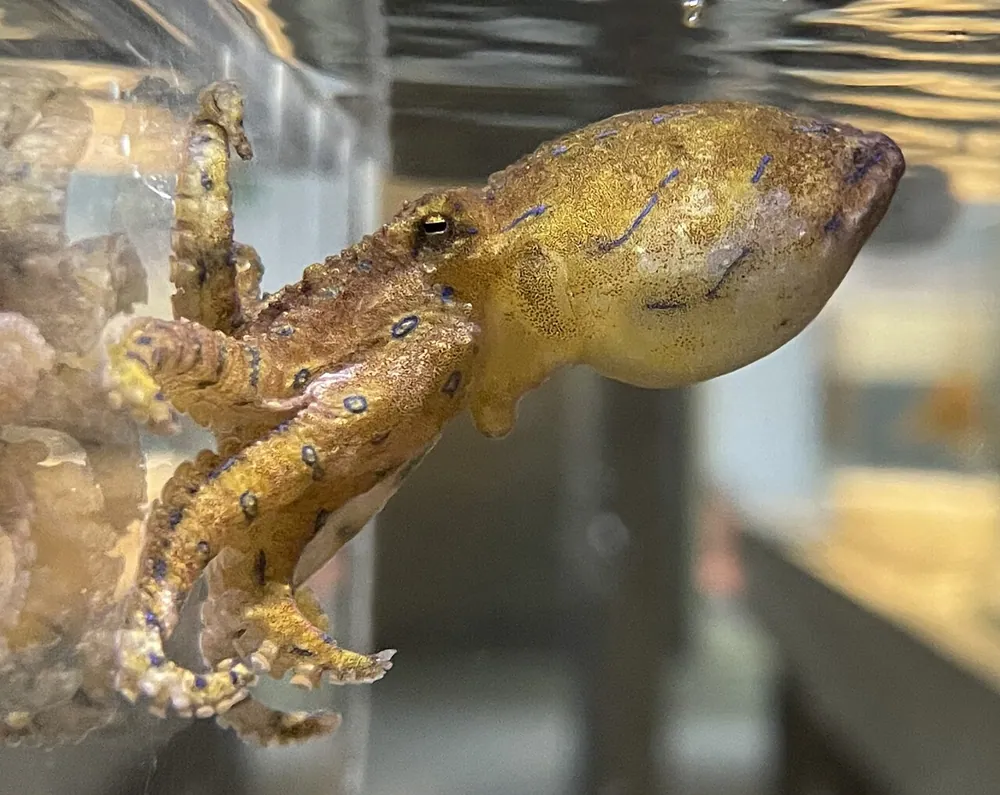
The blue-lined octopus is a small sea creature, about the size of a golf ball, that lives in shallow reefs and rock pools in the Pacific Ocean. It is one of the most dangerous animals in the sea, because its bite contains venom that can be fatal to people. It is shy and usually hides, but its bright blue lines are a clear warning to leave it alone.1
 Cách nhận biết
- At rest, its body is mottled yellow-brown with dark blue or black streaks, and its underside is paler.1
- When it feels threatened, it shows bright, iridescent blue lines across its body.1
- It is small, with a mantle (main body) up to 45 mm long, about the size of a golf ball.1
- Its blue markings are lines, not rings.1
- The visceral hump (the bulge behind the head) is regularly pointed.1
Hay bị nhầm với: The greater blue-ringed octopus, southern blue-ringed octopus and blue-ringed octopus have circular blue rings rather than lines. The blue-lined octopus is also the smallest of the four species in its genus.1
Sức mạnh nọc độc
Nọc độc thoát ra qua răng nanh hoặc răng khi nó cắn.
Nọc độc của nó gây ra gì?
Its venom is tetrodotoxin (TTX), a neurotoxic venom, which attacks the nerves. A bite may not be felt at first. After some time, symptoms include loss of feeling in the tongue and lips, muscle weakness or paralysis, respiratory failure (breathing failure), and unconsciousness, which can lead to death.1
Nó nguy hiểm thế nào với con người?
Nguy hiểm với con người: Chết ngườiMột trong những loài động vật nguy hiểm nhất thế giới.It is regarded as one of the most dangerous animals in the sea, and its venom can be fatal to humans. At least three human deaths have been reported. The greatest risk is to people who pick it up or touch it.1
Nó làm gì khi sợ?
When threatened, it displays bright blue warning lines to predators, and it is more likely to flee and hide in shelter than to fight.1
 Nếu nó cắn
- Băng ép bất động: quấn băng thun thật chắc lên vết cắn rồi quấn tiếp cả chi, nẹp lại và giữ người bị nạn nằm yên hoàn toàn cho đến khi có cứu hộ.
- Bạch tuộc đốm xanh hoặc ốc cối có thể làm người ta ngừng thở trong khi vẫn còn tỉnh: hãy gọi cấp cứu và sẵn sàng thổi ngạt cho đến khi xe cấp cứu đến.
Luôn gọi số khẩn cấp trước tiên (112, 000, 911). Đây là hướng dẫn sơ cứu chung, không phải lời khuyên y tế. Sơ cứu cơ bản
 Giữ an toàn
- Đừng bao giờ chạm, bắt hay trêu chọc động vật hoang dã, dù nó nhỏ, và dù trông như đang ngủ hay đã chết.
- Chừa khoảng cách cho nó. Nếu gặp, hãy bình tĩnh, lùi lại từ từ và để nó đi.
- Nếu nó cắn bạn: bình tĩnh, nằm yên, gọi số khẩn cấp (112, 000, 911) hoặc đến bệnh viện thật nhanh. Hãy nhớ hình dạng nó, có ảnh càng tốt.
Nó không nhắm vào bạn. Nó dùng nọc để bắt mồi hoặc tự vệ, và nó thích trốn hơn nhiều. Thêm về cách giữ an toàn
Ở đâu trên thế giới?
Nó to cỡ nào?
Nó dài bao nhiêu?
 ngắn hơn ngón tay út của bạn
 có thể bơi hết chiều dài hồ bơi lớn (50 m) trong 7,2 giây
Blue-lined octopus to cỡ nào so với BẠN?
Chỉ là phép tính trong trình duyệt của bạn. Không có gì được lưu hay gửi đi đâu cả.
Nó nhanh cỡ nào?

Thông tin
A single 25-gram blue-lined octopus carries enough venom to kill about ten adults weighing 75 kilograms each, according to estimates.1
Male blue-lined octopuses bite the female's aorta during mating, injecting TTX. This paralyses her within about 8 minutes, which lets the male transfer his sperm packets safely.1
Hapalochlaena is the only octopus genus known to produce TTX, a toxin thought to have played an important role in the evolution of the species.1
The blue-lined octopus is the only one of the four blue-ringed species with lined blue markings instead of circular ones.1
Blue-lined octopuses are nocturnal hunters, while the greater blue-ringed octopus hunts during the day.1
Its range has been spreading across the Pacific. Warming ocean water may be shifting suitable habitat, and scientists monitor this for public health and safety.1
Phá tan lời đồn
Lời đồn: Because it is so shy, the blue-lined octopus is not really dangerous.
Sự thật: It is extremely shy and usually flees, but its venom can still be fatal to people, and at least three deaths have been reported.1
Cho chuyên gia về nọc độc
- Tên khoa học
- Hapalochlaena fasciata
- Nhóm
- Ốc cối và bạch tuộc
- Gia đình
- Octopodidae2
- Thứ tự
- Octopoda
- Các châu lục
- Ấn Độ Dương, Thái Bình Dương, Biển San Hô, Các đại dương
- Con non
- A female lays 50 to 100 large eggs about 30 days after mating, hides them under her arms until they hatch, and then dies. The hatchlings take about two months to develop.1
- Nguy hiểm với con người
- 5 / 5: Chết người3
Thông tin lấy từ đâu
- Blue-lined octopus (Wikipedia (CC BY-SA 4.0))
- Hapalochlaena fasciata (iNaturalist): tên gọi và phân loại.
- Venom Wiki: mức nguy hiểm, kích thước điển hình và tốc độ ước đoán là của chúng tôi. Xem cách chúng tôi tính: Cách chúng tôi đánh giá nguy hiểm.
Mỗi thông tin trên trang này có một con số dẫn đến nguồn của nó. Nếu chúng tôi sai điều gì, xin lỗi nhé, chúng tôi là người mê động vật, không phải tạp chí khoa học. Hãy báo cho chúng tôi qua [email protected] và chúng tôi sẽ sửa.
 Bọ cạp đói rồi! Venom Wiki là dự án của một người: miễn phí, không quảng cáo, không theo dõi. Một chút tiền tip giúp trang tiếp tục hoạt động.Cho bọ cạp ăn
Cùng nhóm: Ốc cối và bạch tuộc
 Geography cone
 Greater blue-ringed octopus
 Southern blue-ringed octopus
 Blue sea dragon
 Common octopus
 Giant Pacific octopus
Cũng sống ở: Ấn Độ Dương
 Australian box jellyfishSứa và các loài biển biết đốtChết ngườiĐừng chạm vào
 Hawksbill sea turtleCác loài có độc khácCó thể gây chết người
 Irukandji jellyfishSứa và các loài biển biết đốtCó thể gây chết ngườiĐừng chạm vào
 Reef stonefishCá có nọc độcCó thể gây chết ngườiĐừng chạm vào
 Crown-of-thorns starfishCầu gai, sao biển và giunCần đi khámĐừng chạm vào
 Portuguese man o' warSứa và các loài biển biết đốtCần đi khámĐừng chạm vào