
 Afrique
 Asie
Asie Europe
 Amérique du Sud
 Australie et Océanie
 Antarctique
 Océan Pacifique
 Océan Atlantique
 Océan Indien
 Océan Arctique
 Mer Méditerranée
 Mer Rouge
 Mer des Caraïbes
 Mer de Corail
 Mer de Chine méridionale
 Mer des Philippines
 Mer d'Andaman
 Mer du Nord
 Mer de Timor et d'Arafura
 Golfe du Bengale
 Golfe de Californie
Blue-lined octopus
 Morsures
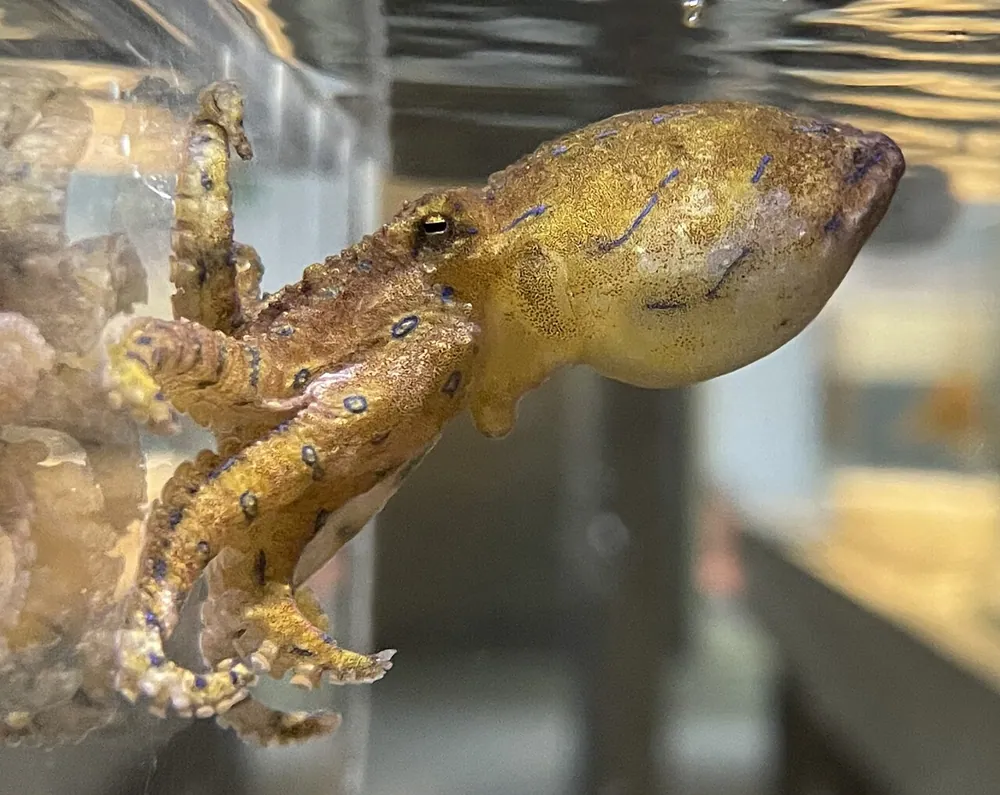
The blue-lined octopus is a small sea creature, about the size of a golf ball, that lives in shallow reefs and rock pools in the Pacific Ocean. It is one of the most dangerous animals in the sea, because its bite contains venom that can be fatal to people. It is shy and usually hides, but its bright blue lines are a clear warning to leave it alone.1
 Comment le reconnaître
- At rest, its body is mottled yellow-brown with dark blue or black streaks, and its underside is paler.1
- When it feels threatened, it shows bright, iridescent blue lines across its body.1
- It is small, with a mantle (main body) up to 45 mm long, about the size of a golf ball.1
- Its blue markings are lines, not rings.1
- The visceral hump (the bulge behind the head) is regularly pointed.1
Souvent confondu avec : The greater blue-ringed octopus, southern blue-ringed octopus and blue-ringed octopus have circular blue rings rather than lines. The blue-lined octopus is also the smallest of the four species in its genus.1
Puissance du venin
Le venin sort par ses crochets ou ses dents quand il mord.
Que fait son venin ?
Its venom is tetrodotoxin (TTX), a neurotoxic venom, which attacks the nerves. A bite may not be felt at first. After some time, symptoms include loss of feeling in the tongue and lips, muscle weakness or paralysis, respiratory failure (breathing failure), and unconsciousness, which can lead to death.1
À quel point est-il dangereux pour l'homme ?
Danger pour l'homme: MortelL'un des animaux les plus dangereux du monde.It is regarded as one of the most dangerous animals in the sea, and its venom can be fatal to humans. At least three human deaths have been reported. The greatest risk is to people who pick it up or touch it.1
Que fait-il quand il a peur ?
When threatened, it displays bright blue warning lines to predators, and it is more likely to flee and hide in shelter than to fight.1
 S'il mord
- Immobilisation par compression : enroule un bandage élastique serré sur la morsure puis sur tout le membre, pose une attelle et garde la personne complètement immobile jusqu'à l'arrivée des secours.
- Une pieuvre à anneaux bleus ou un cône peuvent arrêter la respiration d'une personne encore consciente : appelle les secours et sois prêt à faire du bouche-à-bouche jusqu'à l'arrivée de l'ambulance.
Appelle toujours d'abord ton numéro d'urgence (112, 000, 911). Ce sont des conseils généraux de premiers secours, pas un avis médical. Les bases des premiers secours
 Reste en sécurité
- Ne touche, n'attrape et n'embête jamais un animal sauvage, même petit, et même s'il a l'air endormi ou mort.
- Laisse-lui de la place. Si tu en croises un, reste calme, recule doucement et laisse-le passer son chemin.
- S'il te mord : reste calme, ne bouge pas, appelle ton numéro d'urgence (112, 000, 911) ou va vite à l'hôpital. Souviens-toi de quoi il avait l'air, une photo aide.
Il ne t'en veut pas. Il utilise son venin pour attraper sa nourriture ou se protéger, et il préfère de loin se cacher. Plus d'infos pour rester en sécurité
Où dans le monde ?
Quelle taille fait-il ?
Quelle longueur fait-il ?
 plus court que ton petit doigt
 pourrait nager la longueur d'une grande piscine (50 m) en 7,2 secondes
Quelle taille fait Blue-lined octopus comparé à TOI ?
Juste des calculs dans ton navigateur. Rien n'est enregistré ni envoyé nulle part.
À quelle vitesse va-t-il ?

Faits
A single 25-gram blue-lined octopus carries enough venom to kill about ten adults weighing 75 kilograms each, according to estimates.1
Male blue-lined octopuses bite the female's aorta during mating, injecting TTX. This paralyses her within about 8 minutes, which lets the male transfer his sperm packets safely.1
Hapalochlaena is the only octopus genus known to produce TTX, a toxin thought to have played an important role in the evolution of the species.1
The blue-lined octopus is the only one of the four blue-ringed species with lined blue markings instead of circular ones.1
Blue-lined octopuses are nocturnal hunters, while the greater blue-ringed octopus hunts during the day.1
Its range has been spreading across the Pacific. Warming ocean water may be shifting suitable habitat, and scientists monitor this for public health and safety.1
Démêle le vrai du faux
Idée reçue : Because it is so shy, the blue-lined octopus is not really dangerous.
Vérité : It is extremely shy and usually flees, but its venom can still be fatal to people, and at least three deaths have been reported.1
Pour les experts en venin
- Nom scientifique
- Hapalochlaena fasciata
- Groupe
- Cônes et pieuvres
- Famille
- Octopodidae2
- Ordre
- Octopoda
- Continents
- Océan Indien, Océan Pacifique, Mer de Corail, Les océans
- Petits
- A female lays 50 to 100 large eggs about 30 days after mating, hides them under her arms until they hatch, and then dies. The hatchlings take about two months to develop.1
- Danger pour l'homme
- 5 / 5: Mortel3
D'où viennent les faits
- Blue-lined octopus (Wikipedia (CC BY-SA 4.0))
- Hapalochlaena fasciata (iNaturalist): noms et classification.
- Venom Wiki: le niveau de danger, la taille typique et la vitesse estimée sont les nôtres. Regarde comment on les calcule : Comment on évalue le danger.
Chaque fait sur cette page a un numéro qui renvoie à sa source. Si on s'est trompés, désolés, on est des fans d'animaux, pas une revue scientifique. Dis-le-nous à [email protected] et on corrigera.
 Le scorpion a faim ! Venom Wiki est le projet d'une seule personne : gratuit, sans pub et sans traceurs. Un petit pourboire aide à le garder en ligne.Nourris le scorpion
Plus du même groupe: Cônes et pieuvres
 Geography cone
 Greater blue-ringed octopus
 Southern blue-ringed octopus
 Blue sea dragon
 Common octopus
 Giant Pacific octopus
Vit aussi en: Océan Indien
 Australian box jellyfishMéduses et piqueurs marinsMortelNe pas toucher
 Hawksbill sea turtleAutres animaux vénéneuxPeut tuer
 Irukandji jellyfishMéduses et piqueurs marinsPeut tuerNe pas toucher
 Reef stonefishPoissons venimeuxPeut tuerNe pas toucher
 Crown-of-thorns starfishOursins, étoiles et versNécessite un médecinNe pas toucher
 Portuguese man o' warMéduses et piqueurs marinsNécessite un médecinNe pas toucher