
 Afrique
 Asie
Asie Europe
 Amérique du Sud
 Australie et Océanie
 Antarctique
 Océan Pacifique
 Océan Atlantique
 Océan Indien
 Océan Arctique
 Mer Méditerranée
 Mer Rouge
 Mer des Caraïbes
 Mer de Corail
 Mer de Chine méridionale
 Mer des Philippines
 Mer d'Andaman
 Mer du Nord
 Mer de Timor et d'Arafura
 Golfe du Bengale
 Golfe de Californie
Eastern yellowjacket
 Piqûres
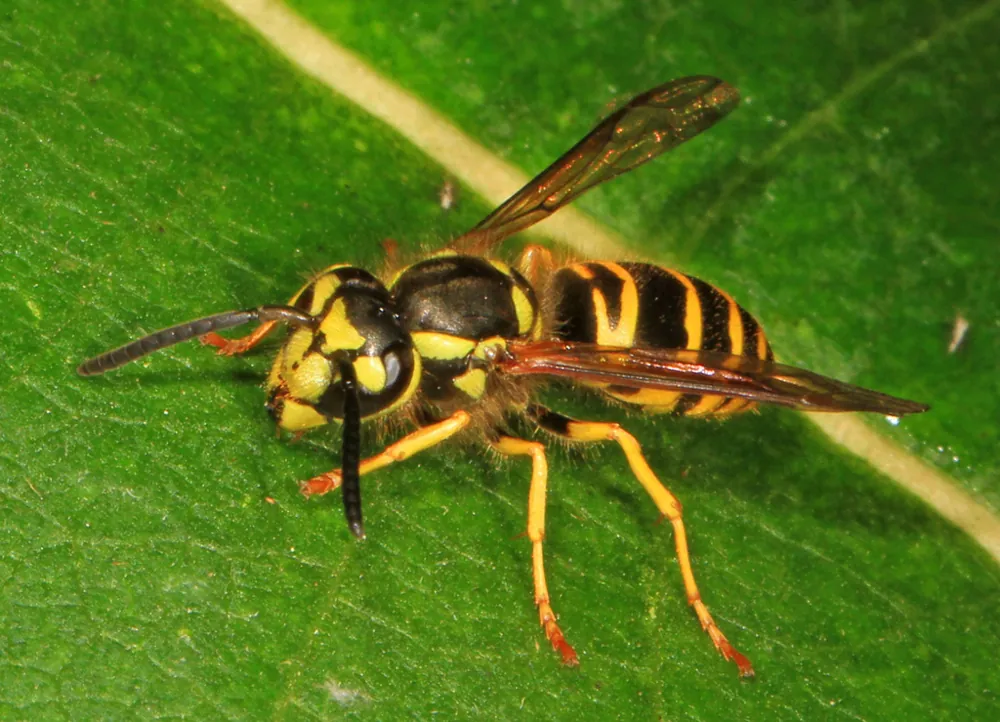
The eastern yellowjacket is a black and yellow wasp that lives in eastern North America. It builds paper nests, many of them underground, and lives in large family groups called colonies. People often meet it around recreational areas and buildings, and it can give a painful sting if its nest is threatened.1
 Comment le reconnaître
- Black and yellow lines on the head, thorax and abdomen1
- Length of about 12.7 to 15.9 mm1
- Spots on the head, which give the species its scientific name1
- Queens have one flared black line nearest the thorax, followed by thinner black lines, with two black dots between each line1
Souvent confondu avec : It can be told apart from other wasp species by its smaller size and its abdominal pattern. Other yellowjacket species are also black and yellow, and in most areas where it lives, this is the most common yellowjacket species.1
Puissance du venin
Le venin sort par un dard.
Que fait son venin ?
Its sting is painful. Wasps, bees, ants and sawflies (the order Hymenoptera) are the leading cause of anaphylaxis in humans, a severe allergic reaction. These reactions are usually triggered by proteins in the venom. Peptides called vespulakinins were first found in this species and are insecticidal, meaning they kill insects.1
À quel point est-il dangereux pour l'homme ?
Danger pour l'homme: DouloureuxÇa peut faire très mal, mais ce n'est presque jamais grave.It is known to inflict painful stings and defends its nest aggressively. Its nests are often treated as a pest because they are found so often in recreational and residential areas.1
Que fait-il quand il a peur ?
When threatened, workers release an alarm pheromone that calls others to attack. Wasps near the nest entrance circle in a zigzag pattern and fly straight at the target.1
 S'il pique
- Gratte le dard d'abeille pour l'enlever et refroidis la zone.
- Si la personne a du mal à respirer, le visage ou la gorge qui gonflent, ou se sent mal, c'est une urgence allergique : appelle ton numéro d'urgence et utilise son stylo d'adrénaline si elle en a un.
Appelle toujours d'abord ton numéro d'urgence (112, 000, 911). Ce sont des conseils généraux de premiers secours, pas un avis médical. Les bases des premiers secours
 Reste en sécurité
- Ne touche, n'attrape et n'embête jamais un animal sauvage, même petit, et même s'il a l'air endormi ou mort.
- Laisse-lui de la place. Si tu en croises un, reste calme, recule doucement et laisse-le passer son chemin.
- S'il te pique : reste calme, ne bouge pas, appelle ton numéro d'urgence (112, 000, 911) ou va vite à l'hôpital. Souviens-toi de quoi il avait l'air, une photo aide.
Il ne t'en veut pas. Il utilise son venin pour attraper sa nourriture ou se protéger, et il préfère de loin se cacher. Plus d'infos pour rester en sécurité
Où dans le monde ?
Quelle taille fait-il ?
Quelle longueur fait-il ?
Combien pèse-t-il ?
 plus court que ton petit doigt
 si léger que tu ne le sentirais pas sur ta main
 pourrait traverser tout un terrain de foot en volant en 16 secondes
Quelle taille fait Eastern yellowjacket comparé à TOI ?
Juste des calculs dans ton navigateur. Rien n'est enregistré ni envoyé nulle part.
À quelle vitesse va-t-il ?


Faits
A large nest can have 10,000 to 15,000 cells, and about a third of them are queen cells.1
The nest envelope is made from chewed, decaying wood mixed with saliva, which makes it fragile.1
The species is a host for a social parasite, Vespula squamosa, which can take over its nests.1
Males gather in groups around prominent trees and bushes, where they patrol and wait for queens.1
Queens can mate with several males, and both queens and males can mate more than once.1
Pour les experts en venin
- Nom scientifique
- Vespula maculifrons
- Groupe
- Abeilles, guêpes et frelons
- Famille
- Vespidae2
- Ordre
- Hymenoptera
- Continents
- Amérique du Nord
- Petits
- A queen founds a new colony in spring by laying eggs in the first cells. The eggs hatch into workers, which then build and enlarge the nest.1
- Danger pour l'homme
- 2 / 5: Douloureux3
D'où viennent les faits
- Eastern yellowjacket (Wikipedia (CC BY-SA 4.0))
- Vespula maculifrons (iNaturalist): noms et classification.
- Venom Wiki: le niveau de danger, la taille typique et la vitesse estimée sont les nôtres. Regarde comment on les calcule : Comment on évalue le danger.
Chaque fait sur cette page a un numéro qui renvoie à sa source. Si on s'est trompés, désolés, on est des fans d'animaux, pas une revue scientifique. Dis-le-nous à [email protected] et on corrigera.
 Le scorpion a faim ! Venom Wiki est le projet d'une seule personne : gratuit, sans pub et sans traceurs. Un petit pourboire aide à le garder en ligne.Nourris le scorpion
Plus du même groupe: Abeilles, guêpes et frelons
 Tarantula hawkAbeilles, guêpes et frelonsFait juste mal
 Executioner waspAbeilles, guêpes et frelonsNécessite un médecin
 Warrior waspAbeilles, guêpes et frelonsNécessite un médecin
 Bald-faced hornetAbeilles, guêpes et frelonsFait juste mal
 Cow killer velvet antAbeilles, guêpes et frelonsFait juste mal
 Eastern cicada killerAbeilles, guêpes et frelonsInoffensif
 Terciopelo
 Eastern coral snake
 Eastern diamondback rattlesnake
 Eyelash viper
 Timber rattlesnake
 Western diamondback rattlesnake