
 非洲
非洲 亚洲
亚洲 欧洲
欧洲 南美洲
南美洲 澳大利亚和大洋洲
 南极洲
南极洲 太平洋
太平洋 大西洋
大西洋 印度洋
印度洋 北冰洋
北冰洋 地中海
地中海 红海
红海 加勒比海
加勒比海 珊瑚海
珊瑚海 南海
南海 菲律宾海
菲律宾海 安达曼海
安达曼海 北海
北海 帝汶海和阿拉弗拉海
 孟加拉湾
孟加拉湾 加利福尼亚湾
Flower urchin
 蜇伤
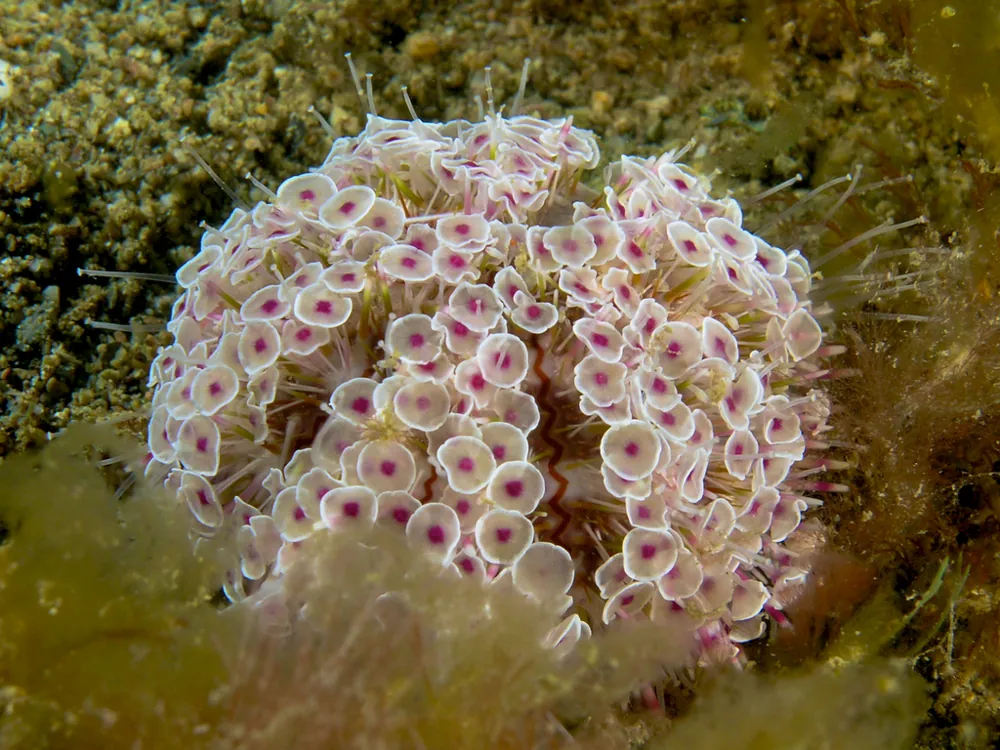
蜇伤The flower urchin is a sea urchin with flower-shaped claws that can sting. It lives on coral reefs, in seagrass beds and on rocky or sandy sea floors across the Indo-West Pacific. It is one of the sea urchins most likely to cause a painful and medically significant sting.1
 怎样认出它
怎样认出它
- Flower-like claws (globiferous pedicellariae) that are pinkish-white to yellowish-white, with a central purple dot and a bright white rim1
- A rigid shell (test) that is deep red and grey, with a purple zigzag pattern along each of the five ambulacral segments; rarely it is greenish or pale purple1
- Short, blunt spines, usually hidden beneath the flower-like claws1
- A body diameter of about 15 to 20 cm1
常被误认为: Other Toxopneustes urchins look similar. Toxopneustes roseus has a uniform pink, brown or purple test and lives only in the eastern Pacific. Toxopneustes elegans, found only around Japan, has a dark stripe just below the tips of its spines. Toxopneustes maculatus is very rare, known from Réunion, Christmas Island and Palmyra Atoll, and has bright violet on its underside and a violet band around its middle.1
毒液之力
毒液通过蜇刺出来。
它的毒液会造成什么?
Its venom is made in glands at the base of the flower-like claws, not in the spines. The claws have sharp fang-like tips that can penetrate human skin, and when touched they snap shut and inject venom. The sting is described as extremely painful and medically significant.1
它对人有多危险?
对人的危险: 非常危险不治疗可能会害死人。It is considered highly dangerous to people. Its stings are extremely painful and medically significant. Larger individuals with bigger claws are thought to be more dangerous, because the strength of the venom is linked to claw size.1
它害怕时会做什么?
When touched or brushed against, its flower-like claws snap shut and inject venom. The claws can break off and stay attached to the skin, continuing to inject venom for several hours.1
 如果它蜇人
如果它蜇人 注意安全
注意安全
- 永远不要摸、抓或逗弄野生动物,即使是很小的,即使它看起来在睡觉或已经死了。
- 给它留出空间。如果遇到它,保持冷静,慢慢后退,让它走自己的路。
- 如果被它蜇了:保持冷静,保持不动,拨打你的急救电话(112、000、911)或尽快去医院。记住它长什么样,拍张照片会有帮助。
它不是冲着你来的。它用毒液捕猎或保护自己,而且它更愿意躲起来。 更多安全知识
它有多大?
它有多长?
 和 6 块玩具积木排成一排一样长
 比花园蜗牛还慢
Flower urchin和你比起来有多大?
只是在你的浏览器里算一算。什么都不会被保存或发送到任何地方。
它有多快?

事实
Unlike most venomous sea urchins, it does not sting through its spines. Its venom is delivered through the claws.1
A zebra crab, Zebrida adamsii, often lives attached to its shell. The crab is thought to be immune to its venom.1
Its flower-like claws are the source of its common name and are its most striking feature.1
Tiny shrimp, Athanas areteformis, sometimes live among its spines.1
In the seashell trade, its empty shells are called "mushroom urchins" because they look like mushroom caps.1
谣言粉碎机
谣言: Sea urchins sting with their spines.
真相: Flower urchins do not deliver venom through their spines. Their venom comes from the flower-like claws, which snap shut and inject it.1
事实的来源
- Toxopneustes pileolus (Wikipedia (CC BY-SA 4.0))
- Toxopneustes pileolus (iNaturalist): 名称和分类。
- Venom Wiki: 危险等级、典型大小和速度估计都是我们自己给出的。看看我们是怎么算的: 我们如何评定危险.
本页的每个事实都有一个编号,指向它的来源。如果我们写错了,抱歉,我们是动物爱好者,不是科学期刊。请写信到 [email protected] 告诉我们,我们会改正。
 蝎子饿了! Venom Wiki 是一个人的项目:免费、没有广告、没有追踪器。一点小小的打赏能帮它继续在线。喂蝎子
 Crown-of-thorns starfish
 Fire urchin
 Bearded fireworm
 Black long-spined urchin
 Bloodworm
 Bobbit worm
 Australian box jellyfish
 Geography cone
 Greater blue-ringed octopus
 Southern blue-ringed octopus
 Hawksbill sea turtle
 Irukandji jellyfish